
Drivetrain
Chassis
Body
Dealer Info
tel: 858-259-0100Symbolic International
409 St Croix
San Diego CA, 54017

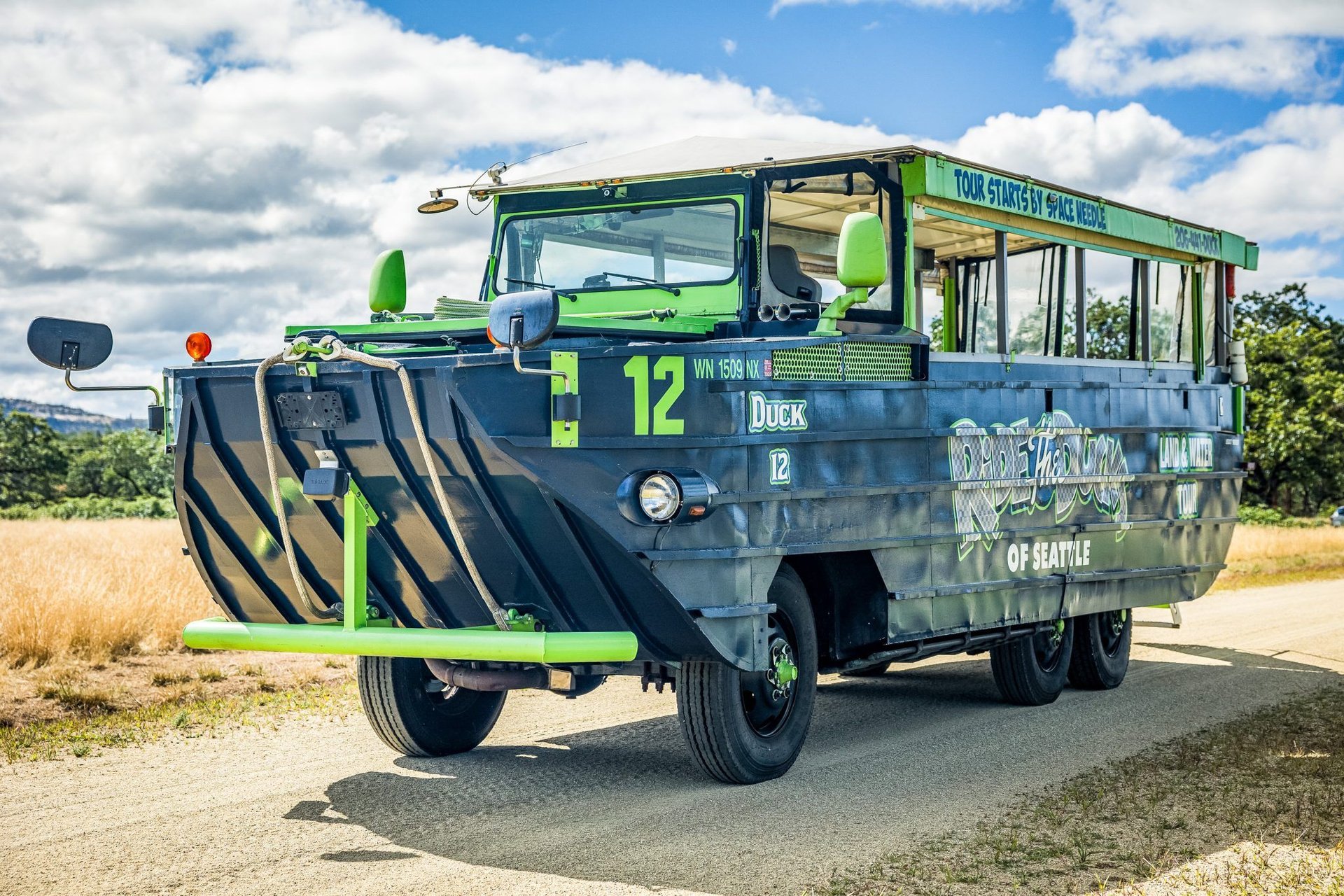
This 6×4 amphibious vehicle is believed to have been assembled in the 1970s using DUKW bodywork over a Studebaker 2½-ton chassis. It was used for recreational tours by Ride the Ducks Seattle before being purchased by the current owner in 2021. The vehicle is finished in blue with green accents, and power is from a 7.3-liter Navistar turbodiesel V8 linked with an Allison four-speed automatic transmission and a duplex drive setup that sends power to the rear drive wheels or to the propeller. The pilot compartment has a high-back bucket seat as well as a rear-facing shotgun seat and sits ahead of eight rows of 2+2 bench seating. Additional equipment includes a Cobra marine radio, a Kenwood CD player, and a surround-view camera system as well as 22.5″ steel wheels, six-wheel disc brakes, and tandem rear drive axles. This DUKW is now offered on dealer consignment with an Oregon title listing it as a 1972 Studebaker and 2026 Oregon marine registration.
The DUKW was designed by yacht designer Rod Stephens, Jr. and several colleagues to carry out military transportation and resupply missions over land and water. Built on a modified GMC cab-over-engine military truck chassis, approximately 21k units were produced during World War II between 1942 and 1945. Reproduction trucks using revised bodywork over chassis from General Motors, REO, and Studebaker are believed to have been built into the 1980s.
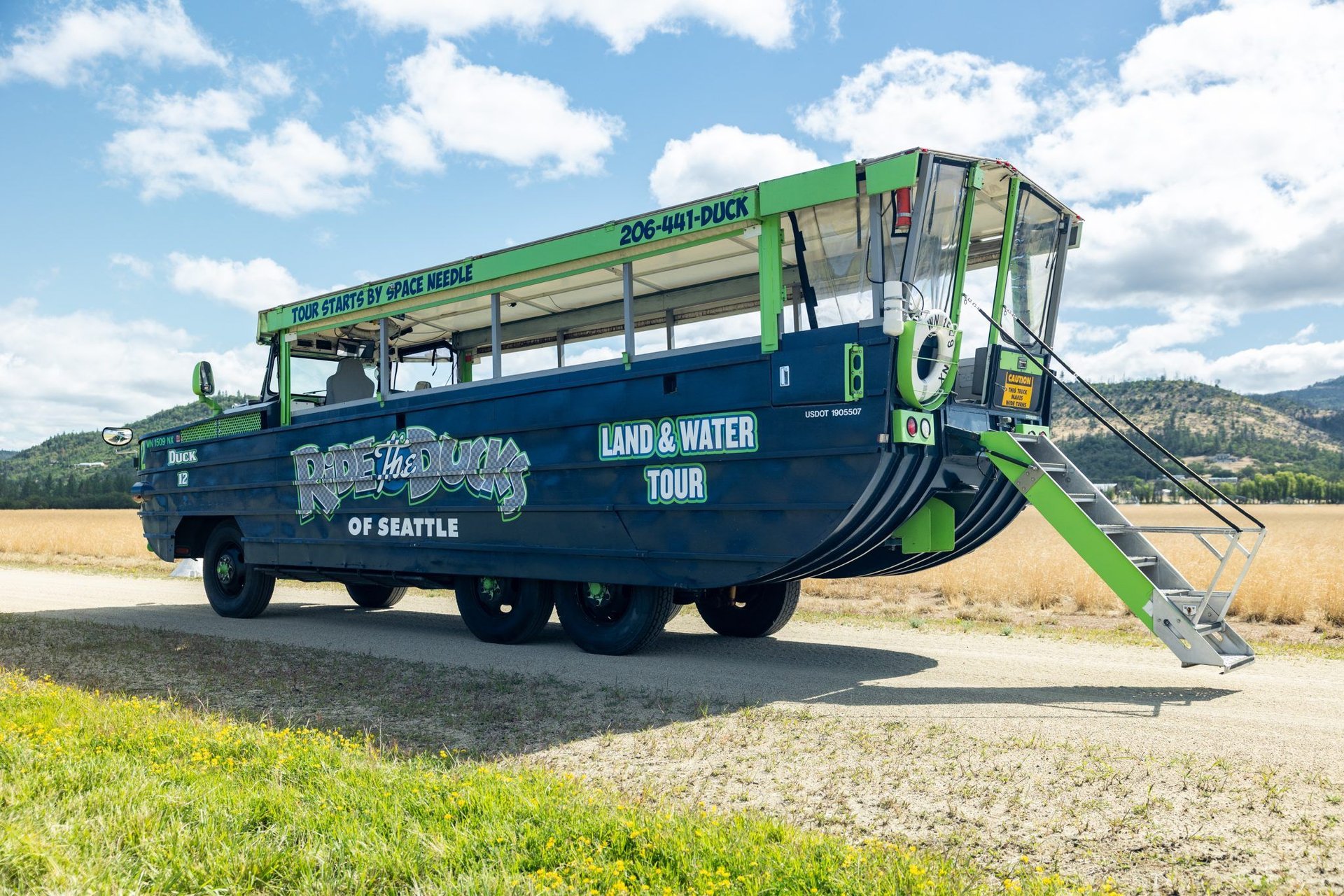
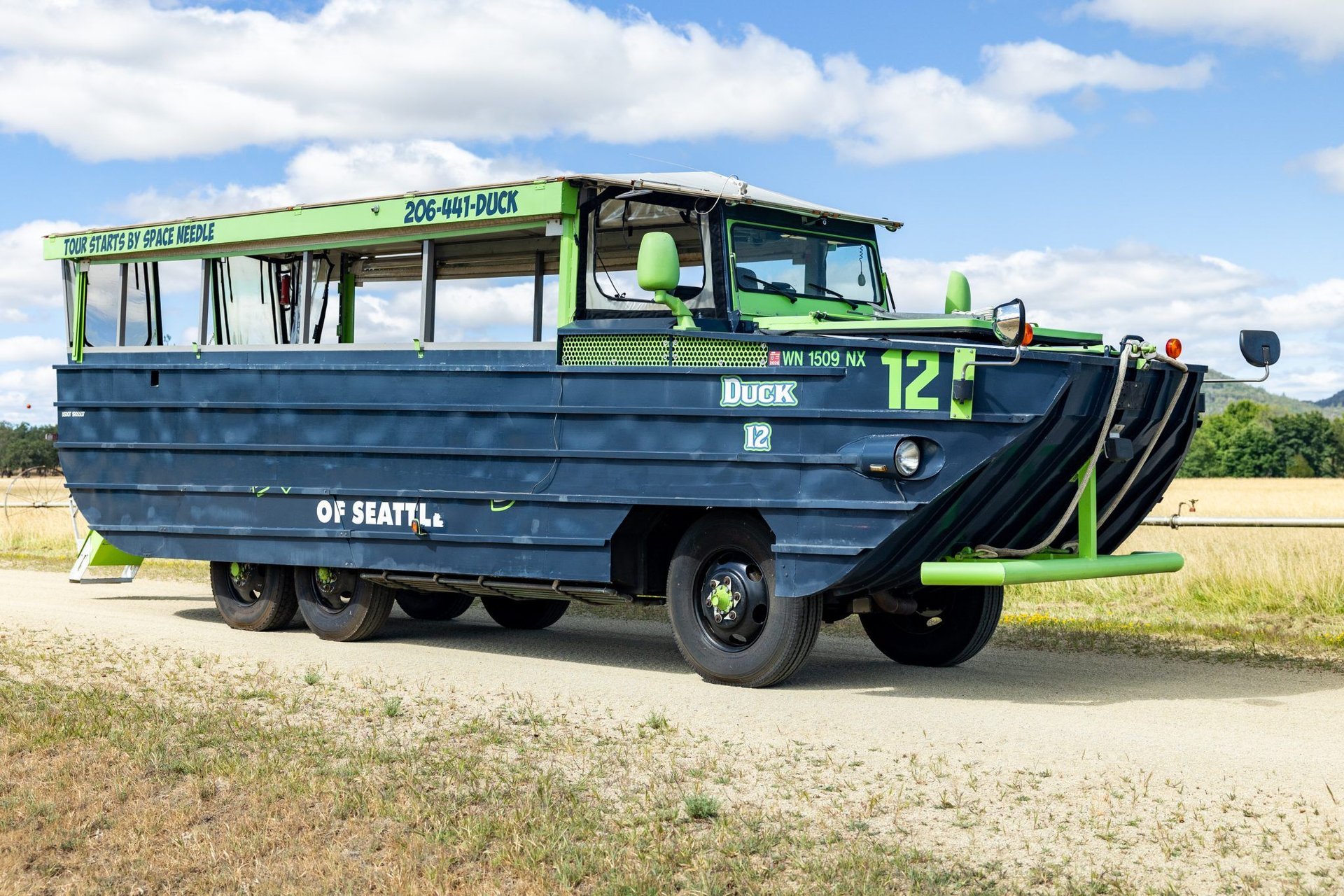
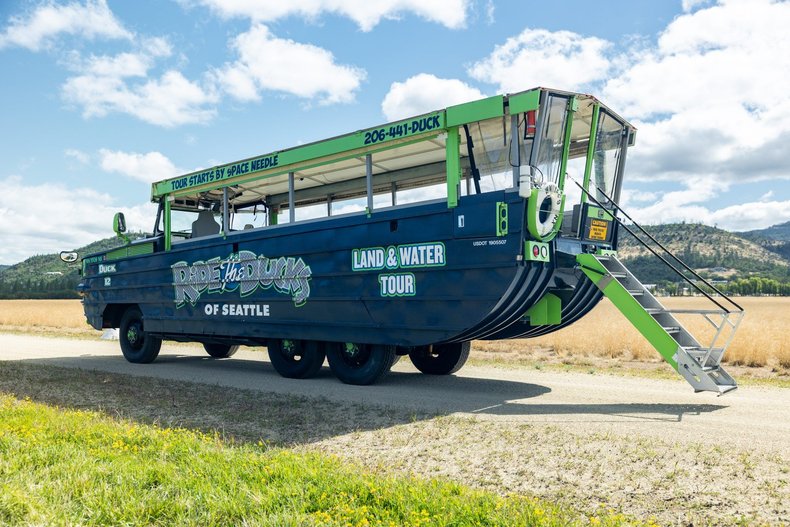
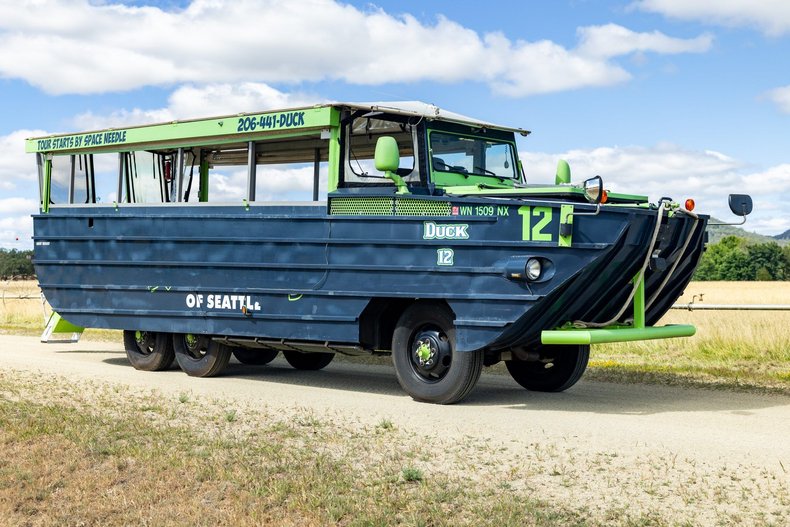
This example is believed to have been built in the early 1970s and modified for use as a tour vessel by Ride the Ducks Seattle. It is finished in blue and green with various promotional graphics and wears a green-painted composite roof over the passenger compartment. Additional features include a steel front bumper, front tow lines, street lighting, turn signals, windshield wipers, dual sets of front mirrors, roll-up side curtains, and retractable rear boarding steps.
The black-finished 22.5″ steel wheels feature green-painted hubs, and they are mounted with Ohtsu Hi-Steel radial tires. The truck is further equipped with tandem rear axles as well as six-wheel disc brakes.
A folding windscreen and zip-out vinyl windows sit ahead of the pilot compartment, which has a single high-back bucket seat trimmed in gray vinyl upholstery as well as a rear-facing shotgun seat with black vinyl–trimmed cushions. A Cobra marine radio, a Kenwood CD player, and a surround-view camera system are mounted overhead. A shifter is mounted to the right of the steering wheel and accompanied by various other vehicle controls including handles for engaging the propeller and parking brake.
A two-spoke steering wheel sits ahead of a 140-mph AutoMeter speedometer, a 3,500-rpm Stewart Warner tachometer, and auxiliary gauges. The truck is equipped with a digital odometer, and the tachometer-housed hour meter shows 15k hours of runtime. Total mileage is unknown.
The rear compartment houses eight rows of 2+2 bench seating upholstered in gray vinyl. The floor panels can be removed to access the transmission housing and drive shaft assembly.
The replacement 7.3-liter Navistar T444E turbodiesel V8 is based on Ford's Power Stroke diesel V8. The engine was rebuilt before being installed under prior ownership.
Shifting is via an Allison four-speed automatic transmission linked with a duplex drive system that can send power to the rear four wheels or the propeller. The front axle has been disconnected from the drivetrain.
The vehicle is titled in Oregon as a 1972 Studebaker using the sequence M60331 shown above. The 2026 Oregon marine registration lists the hull number as 1509NX, which appears on the bodywork. Redacted copies of the title and marine registration are viewable in the gallery.


1972 DUKW 6×4 Amphibious Vehicle
Specifications
- Stock Number
- 1039
- Year
- 1972
- Make
- DUKW 6×4 Amphibious Vehicle
- Vin
- M60331
Description
This 6×4 amphibious vehicle is believed to have been assembled in the 1970s using DUKW bodywork over a Studebaker 2½-ton chassis. It was used for recreational tours by Ride the Ducks Seattle before being purchased by the current owner in 2021. The vehicle is finished in blue with green accents, and power is from a 7.3-liter Navistar turbodiesel V8 linked with an Allison four-speed automatic transmission and a duplex drive setup that sends power to the rear drive wheels or to the propeller. The pilot compartment has a high-back bucket seat as well as a rear-facing shotgun seat and sits ahead of eight rows of 2+2 bench seating. Additional equipment includes a Cobra marine radio, a Kenwood CD player, and a surround-view camera system as well as 22.5″ steel wheels, six-wheel disc brakes, and tandem rear drive axles. This DUKW is now offered on dealer consignment with an Oregon title listing it as a 1972 Studebaker and 2026 Oregon marine registration.
The DUKW was designed by yacht designer Rod Stephens, Jr. and several colleagues to carry out military transportation and resupply missions over land and water. Built on a modified GMC cab-over-engine military truck chassis, approximately 21k units were produced during World War II between 1942 and 1945. Reproduction trucks using revised bodywork over chassis from General Motors, REO, and Studebaker are believed to have been built into the 1980s.
This example is believed to have been built in the early 1970s and modified for use as a tour vessel by Ride the Ducks Seattle. It is finished in blue and green with various promotional graphics and wears a green-painted composite roof over the passenger compartment. Additional features include a steel front bumper, front tow lines, street lighting, turn signals, windshield wipers, dual sets of front mirrors, roll-up side curtains, and retractable rear boarding steps.
The black-finished 22.5″ steel wheels feature green-painted hubs, and they are mounted with Ohtsu Hi-Steel radial tires. The truck is further equipped with tandem rear axles as well as six-wheel disc brakes.
A folding windscreen and zip-out vinyl windows sit ahead of the pilot compartment, which has a single high-back bucket seat trimmed in gray vinyl upholstery as well as a rear-facing shotgun seat with black vinyl–trimmed cushions. A Cobra marine radio, a Kenwood CD player, and a surround-view camera system are mounted overhead. A shifter is mounted to the right of the steering wheel and accompanied by various other vehicle controls including handles for engaging the propeller and parking brake.
A two-spoke steering wheel sits ahead of a 140-mph AutoMeter speedometer, a 3,500-rpm Stewart Warner tachometer, and auxiliary gauges. The truck is equipped with a digital odometer, and the tachometer-housed hour meter shows 15k hours of runtime. Total mileage is unknown.
The rear compartment houses eight rows of 2+2 bench seating upholstered in gray vinyl. The floor panels can be removed to access the transmission housing and drive shaft assembly.
The replacement 7.3-liter Navistar T444E turbodiesel V8 is based on Ford's Power Stroke diesel V8. The engine was rebuilt before being installed under prior ownership.
Shifting is via an Allison four-speed automatic transmission linked with a duplex drive system that can send power to the rear four wheels or the propeller. The front axle has been disconnected from the drivetrain.
The vehicle is titled in Oregon as a 1972 Studebaker using the sequence M60331 shown above. The 2026 Oregon marine registration lists the hull number as 1509NX, which appears on the bodywork. Redacted copies of the title and marine registration are viewable in the gallery.